|
2024
|
Dr Ram Asrey
|
Principal Scientist & Professor
|
BOS Member, SKN Agriculture University, Bikaner
|
|
2024
|
Dr Ram Asrey
|
Principal Scientist & Professor
|
IMC, Member, ICAR-CIAH Bikaner
|
|
2024
|
Dr Ram Asrey
|
Principal Scientist & Professor
|
IMC, Member, ICAR-IIHR Banluru
|
|
2024
|
Dr Ram Asrey
|
Principal Scientist & Professor
|
Editor-in-Chief Indian Journal of Horticulture
|
|
2024
|
Dr Ram Asrey
|
Principal Scientist & Professor
|
Editor- Plant Growth Regulation (Springer)
|
|
2024
|
Dr Shalini Gaur Rudra
|
Senior Scientist
|
Associate Guest Editor, Frontiers in Sustainable Food Systems
|
|
2025
|
Dr Shalini Gaur Rudra
|
Senior Scientist
|
3rd Prize for Oral Presentationduring National Conference on “BIO3- Biotechnology, Bioengineering and Bioeconomy” organized by the Department of Biotechnology, Thapar Institute of Engineering & Technology (TIET)
|
|
2025
|
Dr Shalini Gaur Rudra
|
Senior Scientist
|
Best researcher Award in International Innovator Awards (4th edition) by Innovatorawards.org, a group of Scifax company (Reg. No.159522), approved and registered by the Ministry of Corporate Affairs.
|
|
2024-26
|
Dr Shalini Gaur Rudra
|
Senior Scientist
|
Joint Secretary (Asia), Society for Plant Research for the term 2024-2026
|
|
2024-26
|
Dr Shalini Gaur Rudra
|
Senior Scientist
|
Associate Guest Editor, Frontiers in Sustainable Food Systems
|
|
2024
|
Dr. Alka Joshi
|
Senior Scientist
|
‘Outstanding Woman Horticultural Scientist Award’ by Society for Horticultural Research and Development (SHRD); and two Best oral presentation (First) award in the “7th AMIFOST”
|
|
2024
|
Dr. Anamika Thakur
|
Scientist (Senior Scale)
|
One Best oral presentation (First) award in the “7th AMIFOST”
|
|
2024
|
Dr. Anamika Thakur
|
Scientist (Senior Scale)
|
Received Global Business Achievers Award by Global Manufacturers & Traders Foundation
|
|
2025
|
Alka Joshi
|
Senior Scientist
|
Antioxidant Rich Papaya Candy selected by Agrinnovate India (AgIn) and Kerala Startup Mission (KSUM) under the Branding Challenge 2.0 and screened under top two as a technology having commercial potential
|
|
2025
|
Alka Joshi
|
Senior Scientist
|
Pusa Vishist Pravakta Award (hindi)
|
|
2026
|
Neelam Upadhyay
|
Senior Scientist
|
Best Woman Scientist Award (IARI)
|
|
2026
|
Neelam Upadhyay
|
Senior Scientist
|
Best Research Publication award (IARI)
|
Trainings Conducted
|
S. No.
|
Name of training programme
|
Date
|
|
1.
|
ICAR sponsored winter school on Recent Advances in Food Processing Technologies for Agri-Horti Produce
|
21 days (15 Jan - 4 Feb 2025)
|
|
2.
|
ADP on Recent avenues in Food Processing Technology for Agritech Startups
|
6 days (8-13 sept 2025)
|
|
3.
|
Two days training programme cum seed and inputs distribution programme in Processing Techniques for Horticultural and Arable Produce (off campus-Uttarakhand)
|
13.10.2025 to 14.10.2025
|
|
4.
|
21-Day Winter School on Recent Advances in Food Processing Technologies for Agri-Horti Produce
|
16.01.2025 to 05.02.2025
|
Significant Research Findings
· Natural plant extract for the elaboration of black garlic from single clove garlic
Maillard reaction products (MRP) are emerging as future additives as emulsifiers, technological ingredients, and flavouring agents for food industry. Black garlic is an important candidate product rich in MRP and Amadori compounds. In the present investigation a green process employing moisture-assisted aging technology (MAAT) was employed to develop black garlic (BG) from single clove variety (Solo) from Himachal Pradesh India. Phenolic rich extract from Aonla (Emblica officinalis) or Indian gooseberry was infused through vacuum impregnation in pre-treated peeled garlic. The changes in physicochemical parameters, non-enzymatic browning, functional quality, reducing sugar and FTIR (Fourier-transform spectroscopy) were monitored during aging. The modified MAAT process modulated quick transformation of fructan into fructose, increased degree of glycation and shortened aging time. The infusion of phenolic and ascorbic acid rich extract accelerated the Maillard reaction (MR), and improved the functional quality of BG.
· In-vitro and in vivo efficacy of plant extracts against postharvest pathogens
Efficacy of ornamental plant extracts (leaf and petal of rose and marigold) against postharvest fungi was assessed. In vitro studies revealed that extracts at a total phenolic concentration of above 150 mg GAE mL-1, inhibited the growth of Colletotrichum gloeosporioides, Rhizopus stolonifer and Aspergillus niger, with rose leaf extract showing the highest inhibition percentage followed by marigold petal extract. In-vivo experiments demonstrated that higher phenolic concentrations (200 mg GAE mL-1) outperformed lower concentrations, with marigold petal extract remarkably reducing lesion diameter and decay percentage across all fungal strains. Rose leaf and marigold petal extracts, particularly at 200 mg GAE mL-1, emerged as natural alternatives for controlling postharvest fungal infections in guava fruits.
· Utilization of fresh pea pod shells for recovery of stabilized green biocolourant
Experiments were carried out to maximise the extraction of chlorophyll from pea pod pomace using ultrasonication, and enzyme-assisted extraction. Addition of cellulase enzyme at concentration of 49.975 IU/g delivered maximum chlorophyll recovery of 43.15 mg/100g. Storage temperature of the stabilized chlorophyll below 25°C under dark conditions at pH 7.0 is the best to get maximum stability of the pigment for its effective utilization as a natural green colourant.
· Characterization and efficacy of mango kernel phenolics for reducing postharvest fungal diseases in strawberry
Nine different concentrations ranging from 0 to 1500 ppm of mango kernel phenolics extract (MKPE) from pickling variety of mango were tested against three main post harvest pathogens namely Botrytis cinerea, Colletotrichum gloeosporioides and Rhizopus stolonifera. Radial growth in millimeter and percent inhibition of mycelial growth were calculated based on the efficacy of MKPE on the three pathogens. MKPE showed good antifungal property against all the three pathogens. Botrytis showed 1.53 mm, Colletotrichum showed 3.40 mm and Rhizopus showed 2.80 mm of radial growth at higher concentration of 1500 ppm. Among the three pathogens, Botrytis cinerea was found most sensitive (EC50=364 ppm) to MKPE while Rhizopus stolonifera (EC50=925.58 ppm) and Colletotrichum gloeosporioides (EC50=963.80 ppm) were more tolerant. The infection by Botrytis cinerea was delayed by 7 and 8 days upon functionalizing the MMKS edible coating with 360 ppm and 4800 ppm MKPE, respectively. Fig 1 is showing strawberries coated with edible coatings of modified mango kernel starch during in vivo experiments with Botrytis.
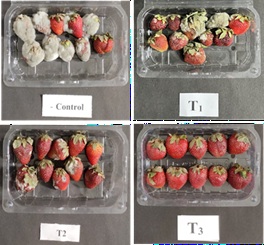
Control; STMP modified starch (T1); STMP starch with mango kernel phenols at EC50 level (T2); STMP starch with mango kernel phenols at EC90 level (T3)
· GABA content in tomatoes: Impact of genotype, maturity stage and processing regime
Gamma-aminobutyric acid, widely known as GABA, serves as a major neurotransmitter inhibitor in the central nervous system of humans and animals. Tomato being its richest source of GABA among vegetables was focused to identify its best maturity stage for GABA accumulation as well as its best way of utilization through degradation studies under different processing and storage regimes. Seven tomato hybrids namely ‘H-81’,‘H-684’, ‘H-162’, ‘H-507’, ‘H-572’, ‘H-561’ and ‘Candy’were evaluated for their GABA content at six different maturity stages: immature green, green, breaker, turning, pink, and ripe. In all the genotypes, GABA content was maximum at the green stage and declined as the fruit ripened. When processed into puree (approximately 14°B) using hot and cold break methods, the GABA content diminished over time and followed first order kinetics. Concentration of pulp during cold and hot break resulted in GABA degradation at the rate of 0.334 mg/gmin-1 and 0.359 mg/gmin-1, respectively. Different exposure conditions (natural light, dark, diffused light, and refrigeration) affected GABA content in tomato slices, in which diffused light exposure resulted in the least while natural light resulted in maximum degradation of GABA. The obtained results are helpful in the identification of best way of processing and consumption of tomato as a rich source of GABA.
· Freeze assisted extraction of betalain for enhanced recovery from beetroot
A freeze assisted extraction protocol has been standardized for a more concentrated yield of betalains pigment from beetroot over the conventional (solvent extraction) method (Fig 2). Freezing of beetroot (− 20 oC using freezer) followed by thawing as a pretreatment before extraction led to disruption of beetroot microstructure, enhanced cell permeability, which increased the mass transfer rate and thus the extraction yield (approximately 52 percent higher than the conventional method).

Beetroot and its extracted colourant
· Low calorie bakesafe sweetener for cookies
Different polyols were screened for use as bake safe sweetener in cookies from refined flour. Amongst xylitol, maltitol, isomalt, sucralose, four polyols were incorporated in cookies for complete replacement of sugar. Four factor three level response surface methodology was employed to optimize the best combination of polyols with most acceptable taste, spread ratio, colour, hardness and fracturability. The best combination of polyols was able to replace sugar in cookies fully without compromising the quality parameters of refined flour cookie. Carrot juice concentrate (23 oB) was used at levels of 24% flour weight basis to enrich cookies with carotenoids. Spread ratio of control cookies was 9.5 while that of optimum combination was 11.4 with overall acceptability scores were 9 and 8.7, respectively. Colour values were also found acceptable with Hunter L value of 76.64 (control) and 70.65 (optimum combination).
· Nutri-prash: A convenient healthy bar
Method for formulation (2x3 factorial experiment) of nutri -prash using aonla, beetroot and moringa was optimized based on sensory evaluation and texture profiling using 2 way ANOVA (Fig 3). The optimized product was compared with control for proximate, physico-chemical analysis, textural study and tribology. The product contained total phenolic content, total flavonoid content, antioxidant activity significantly higher than Control 2 (containing beetroot and aonla), while significantly lower than Control 1 (containing only aonla). The developed product contained significantly (p<0.05) higher carotenoid content and sensorial (flavor, colour and appearance; and total score) than both the controls. The developed product showed superior thermal stability than both the controls. The developed product showed intermediate cell viability (except at 10 microgram per ml) and hydrodynamic friction (expressing tribology) than both the controls.
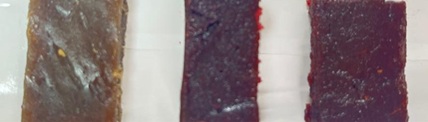
Control 1; Control 2 and Developed product
· Functionalized extruded snacks
Extrusion process has been optimized for the development of tomato pomace-corn extrudates (Fig 4). Tomato pomace, although a food industry waste, is an excellent source of lycopene and dietary fiber. Similarly overripe banana powder and grape pomace are excellent source of natural sweeteners, fiber and bioactives. Utilization of these nutrient rich wastes from agro- processing industries as a functional ingredient in commercially acceptable products such as extruded puffs can pave way for dual benefit of waste and rejected fruit utilization as well as improved nutritional composition of commercially available snack products
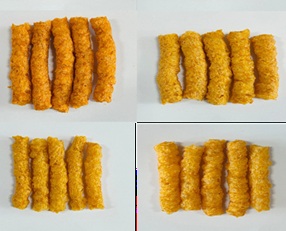
Tomato pomace containing puffed extrudates
· Functionalized peapod powder instant noodles
Process of extrusion functionalization of pea pod powder to be used as an ingredient in instant noodles was optimized (Fig 5). Extrusion modifies the protein structure in pea pod powder without compromising the antioxidant capacity of the final product. Functionalization of pea pod powder through extrusion can be a viable approach to utilizing this waste product as a nutrient-rich ingredient in popular food items such as instant noodles. The properties of noodles with functionalized pea pod powder were comparable to those of control noodles without pea pod powder. Thus, structural alteration offers a promising solution to utilize pea pod powder as a nutritious and sustainable ingredient in popular food products.

Peapod powder containing instant noodles